
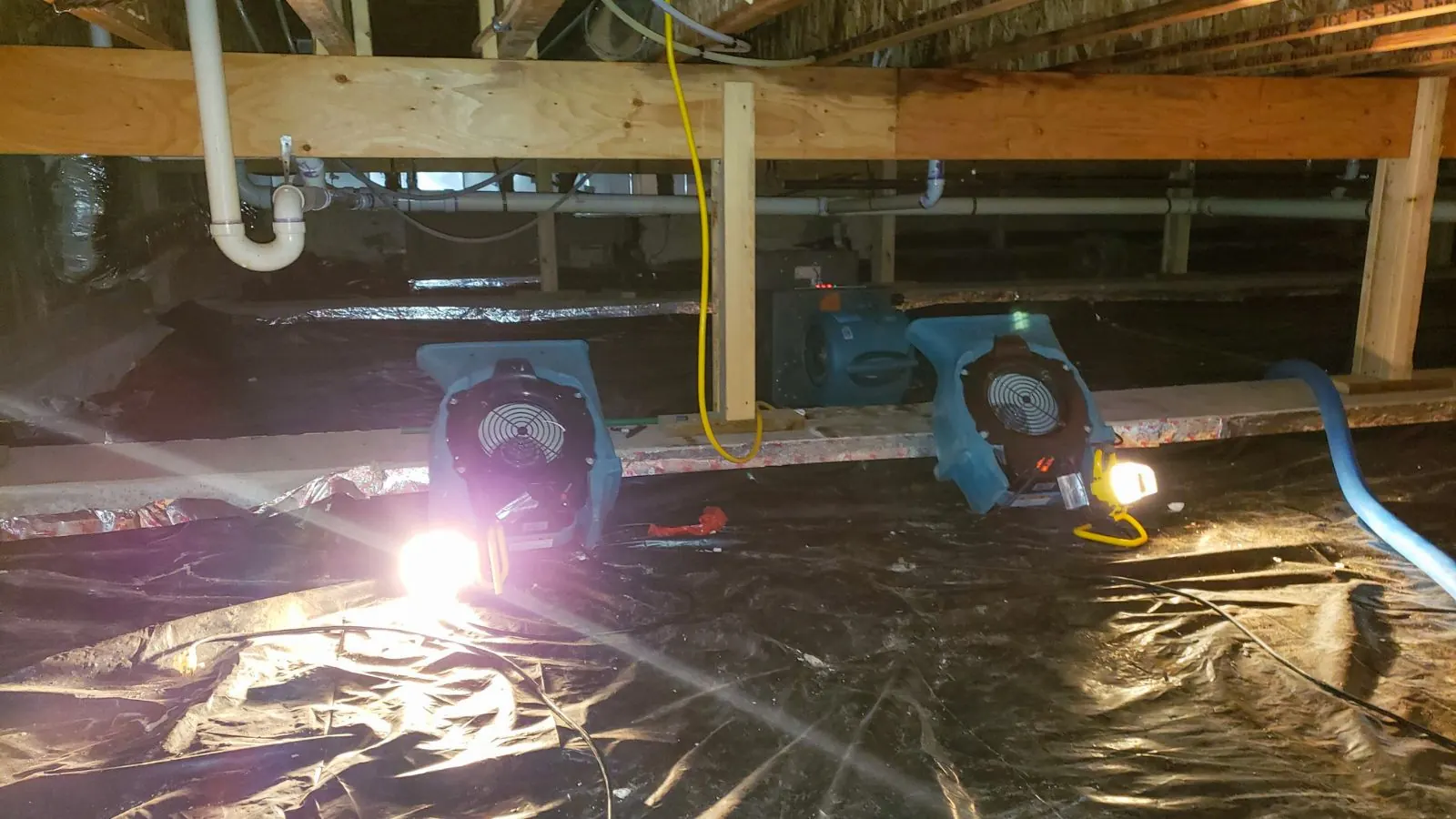
What counts as crawl space water damage in Lithia Springs, GA
A crawl space is the shallow void between the soil and the underside of your floor. When water collects there, from a leaking supply line, a clogged drain, or runoff that finds a low corner, the damage is to the subfloor, joists, insulation and the air that rises into your living space.
This page covers that under-floor void only. If the wet area is a finished room below grade, see our basement cleanup page instead. If water is standing in the house itself, the first job is removal, which is a different job.
Crawl spaces dry slowly because the air is still and the soil keeps giving off moisture. A wet joist can sit above its dry reading for weeks if nobody measures it.
Signs the space under your house is holding water
Most owners never go down there. These are the clues that show up upstairs or at the vents.
Floors that move
Soft spots, bounce, or hardwood boards that cup at the edges point to a subfloor that is absorbing moisture from below.
A musty smell from the vents
Air from the void is pulled into the house by the stack effect. A cellar smell that gets stronger on humid days is a typical complaint.
Sagging or fallen insulation
Fiberglass batts hold water and drop away from the joists once they are heavy. Torn black vapor barrier is a second sign.
Wet soil, pooling or white crust
Standing water, dark soil, or a chalky mineral crust on block walls shows that water has been entering for a while.
Call the 24/7 line about your crawl space
Describe what you see and we will tell you how the dispatch works. Call (943) 469-0138.
Why this area's rain and housing age matter underfoot
NOAA's 1991 to 2020 climate normals for Atlanta Hartsfield, the nearest long-record station, give about 50 inches of rain a year, and no month in the record falls below roughly 3 inches. Soil here rarely gets a long dry spell, so a crawl space with poor drainage stays damp. Check where your gutters and downspouts discharge, because water dropped beside the foundation walks right under the house.
Douglas County's Lithia Springs Small Area Plan describes most homes as built between about 1940 and 1980, mainly minimal traditional and ranch styles. Homes of that age often have older supply plumbing and original vents. Walk your own crawl space entrance and note what you see before any work starts.
How we dry and stabilize a wet crawl space
Work follows the published ANSI/IICRC S500 water standard. The sequence below is typical, and your scope may skip or add steps.
Stop and find the source
A moisture meter and a thermal imaging camera show which joists and subfloor panels are wet. Then the source is traced: a supply leak, a drain, or surface runoff.
Remove standing water
Submersible pumps and extraction units pull water off the soil and vapor barrier. Saturated insulation is cut out and bagged because it will not dry in place.
Dry the structure
Air movers sit under the floor to push air across wood. LGR dehumidifiers run on ducting to pull moisture out of the void rather than recirculate it.
Verify with readings
Meter readings on framing are logged each visit. Equipment comes out when the wood reaches its dry standard, not when a set number of days has passed.
What the condition under the floor tells us to do
| What we find | What it usually means | What is done |
|---|---|---|
| Damp soil, no standing water | Humidity or slow seepage | Dehumidify, cover bare soil, fix drainage |
| Standing water over soil | Active leak or runoff entry | Pump out, find the source, dry framing |
| Wet batts and sagging barrier | Insulation has absorbed water | Remove and replace insulation, dry joists |
| Dark growth on wood | Moisture has lasted a while | Containment and mold work to S520, see mold remediation |
Dark staining alone does not prove mold. Testing and a physician are the right route for health questions.
Encapsulation, ventilation or drying only: honest trade-offs
Drying alone fixes the current event. It does not stop the next wet spell if the cause is grading or a vent that pulls humid summer air into a cool space.
Sealing the space with a heavy vapor barrier on the floor and walls, plus a dehumidifier, controls humidity year round. The trade-off is upkeep: a unit that fails quietly lets the space drift wet again, so it needs periodic checks. Open vents suit some foundations and hurt others, and the right call depends on how your house is built.
Where equipment is needed beyond the crawl space, our structural drying page explains how a whole drying plan is measured. That plan applies to every wet material in the house.
What drives the cost of crawl space work
There is no honest flat number for this job, because no two voids are alike. These are the factors that set the scope.
Water category
Clean supply water is simpler than a drain overflow, which needs removal of affected materials.
Access
A tight entrance and low clearance slow every task and change the equipment that fits.
Square footage and depth
Larger voids need more air movers and dehumidifier capacity.
Materials removed
Insulation, vapor barrier and any subfloor panels that cannot be dried drive the rebuild scope.
Drying days
Wood and soil dry slowly, so monitoring days vary with how long water was present.
Insurance often treats sudden and accidental water as a covered event, while long-term seepage and neglect are commonly excluded, and flood is usually a separate policy. Check your policy or ask your insurer before you decide anything. Crawl space jobs vary a lot with access, so call (943) 469-0138 for a figure that fits yours.
Related work and nearby service
Raised floors can also mean wet hardwood above, which we cover on the hardwood floor repair page. If your home is closer to Mableton, we dispatch there too, see Mableton water damage service.
Common Questions
How do I know if my crawl space has a water problem?
Look for a musty smell, soft floors, sagging insulation, or damp soil. A flashlight and a look from the entrance will show standing water. If you are unsure, call (943) 469-0138 and describe what you see.
Can wet crawl space insulation be dried and reused?
Usually not. Fiberglass batts that have soaked up water lose their grip on the joists and hold moisture against the wood. Removal is typical, and replacement happens after the framing is dry.
Should I run a fan or dehumidifier myself first?
A household dehumidifier cannot pull a whole void dry. Fans can spread contaminated water residue if the source was a drain. Stop the water source and let crews measure first. The drying process is laid out on our page about water removal.
Is crawl space mold something I should clean myself?
Mold needs moisture, so removal without drying fixes nothing. Remediation and testing follow the S520 standard. Health questions belong to a physician. Ask any company whether its crews work to S520, and ask whether Georgia licenses the work.
Does homeowners insurance pay for crawl space water damage?
Sudden and accidental damage, like a burst supply line, is often covered. Gradual leaks and flood are often not. Read your policy and ask your insurer.
How long does a crawl space take to dry?
Soil and wood release moisture slowly, so the answer is measured in readings rather than a fixed day count. Crews log meter results and remove equipment once framing reaches its dry standard.